
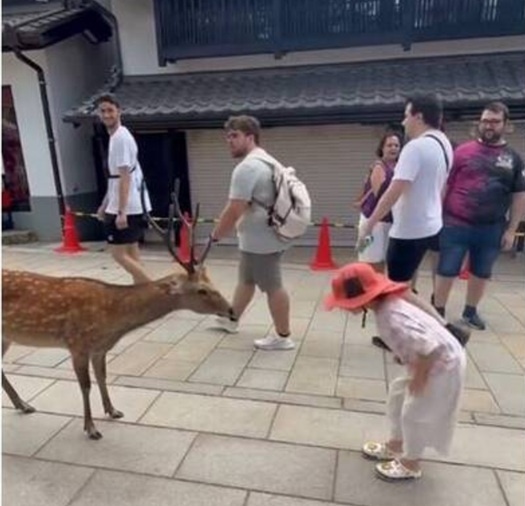
In Nara Park, Japan, children from Taiwan are engaging in a "cute dialogue" with the sika deer. (Video screenshot)
[People News] Recently, a video featuring Taiwanese children feeding deer in Nara Park, Japan, and having a "cute dialogue" with the sika deer has taken the Japanese internet by storm.
Feeding deer in Nara Park is a must-see attraction for foreign tourists.
A Japanese netizen recently shared a video showing a little girl wearing a fisherman's hat. When she saw a sika deer approaching her for food, she said "nod" while simultaneously nodding and bowing herself. The sika deer responded by nodding back, and both the girl and the deer were bowing and nodding to each other.
The little girl then flashed a sweet smile and carefully fed the sika deer the "deer senbei" she held in her hand. After feeding, she waved her hand and, in a soft, childlike voice, told the sika deer, "Okay, that's it!"
This heartwarming "cute dialogue" captivated the foreign tourists nearby, with nearly everyone smiling as they watched the entire interaction.
After viewing the video, some netizens remarked that the "cute dialogue" between the little girl and the sika deer brought out an involuntary "auntie smile" from those around them.
The term "auntie smile" originates from the Korean fan community and describes the affectionate and indulgent smile that naturally appears when one sees something or someone they adore and find adorable.
According to a report by the Liberty Times, the release of this video quickly garnered praise from tens of thousands of online users. Many Japanese commenters remarked: 'The people of Taiwan are truly different from a certain country!' 'So adorable! Taiwanese people speak softly, have gentle and amiable personalities, and their national quality is very high!', 'Please continue to be our good neighbors', 'If all foreign tourists behaved like this, it would be wonderful', 'The children of Taiwan treat Mr. Deer gently and wave goodbye cutely; it's such a warm and beautiful scene', 'Taiwanese people are different from the country that abuses deer!'.
The report noted that many Japanese commenters referred to 'a certain country', which actually means China. This is in reference to previous incidents where Chinese tourists violently mistreated the deer in Nara, engaging in abusive behaviors such as kicking and hitting, which drew widespread condemnation on Japanese social media. Some commenters under the video claimed that the child in the video spoke with a slight retroflex sound, suggesting they were 'obviously' Chinese, but other netizens quickly countered: 'Regardless of where they are from, have you considered why Japanese people think of Taiwanese people first when they see someone speaking Chinese politely? And when they see rudeness, they immediately think of Chinese people?'
A piece of deer senbei highlights the significant differences across the Taiwan Strait.
The sika deer in Nara Park are famous for 'bowing to ask for senbei', making it a signature experience for many tourists visiting Nara.
However, in recent years, with the surge of international tourists, the differences in 'human-deer interaction' at Nara Park—particularly the rude behavior of Chinese tourists compared to the polite and friendly actions of other visitors—have created a striking contrast.
The differences in behavior exhibited by tourists from both sides of the Taiwan Strait in Japan, ranging from feeding deer in Nara Park to daily travel and public etiquette, reflect the distinct paths taken in social evolution, education, systems, and cultural preservation. This topic has been a long-standing focus of discussion among sociologists and online communities.
Cultural scholars have noted that Taiwan has managed to preserve the core elements of traditional Chinese culture throughout its historical development. This includes Confucian values such as 'propriety, righteousness, integrity, and shame,' as well as 'gentleness, goodness, respect, frugality, and humility.' These values are evident in family education, moral education in schools, and social norms, with everyday expressions like 'please, thank you, and sorry' deeply embedded in social habits. Furthermore, Taiwanese society has integrated modern democratic principles and civic literacy, creating a cultural atmosphere that blends traditional gentleness with contemporary civic etiquette.
In contrast, mainland China has undergone numerous political movements and social transformations in the 20th century, such as the Four Olds campaign and the Cultural Revolution, which have significantly disrupted traditional Confucian moral standards and religious belief systems. Generations have been raised under the influence of atheism, class struggle, and collectivism, resulting in a serious break in the cultural continuity of the traditional 'land of propriety.' Although the government has recently begun to advocate for 'excellent traditional Chinese culture,' this often manifests as grand narratives or political propaganda, with less emphasis on fostering equal respect and micro-cultivation among individuals in everyday life.
The concept of 'wolf culture' and aggressive behavior.
Numerous commentators have noted that in the high-pressure and competitive social environment of mainland China, often referred to as 'involution,' many individuals are instilled from a young age with the survival principle of 'if you don't compete, you will be eliminated.' This mindset is evident in public spaces, where it often manifests as a lack of boundaries, a rush to be first, or a noticeable resistance to public regulations.
Additionally, many internet users have pointed out that in tourism and consumption contexts, some mainland tourists frequently display an attitude of 'I spent money, so I am in charge.' They view feeding wild animals as a transaction, believing that 'I bought food, so you must comply with me.' When the animals do not cooperate, it can lead to irritability or aggressive behavior. Such actions and attitudes reflect a deficiency in the traditional moral principle of 'reverence for nature and kindness to all living things.'
A piece of deer senbei in Nara Park not only highlights the quality of personal upbringing but also illustrates the significant impact of the differing systems and cultural environments across the strait on the character of the people. The true measure of a society's 'civilization' is not its economic scale or military power, but rather whether its citizens can exhibit genuine respect and kindness towards the weak, nature, and public regulations.
(First published in People News)
△






News magazine bootstrap themes!
I like this themes, fast loading and look profesional
Thank you Carlos!
You're welcome!
Please support me with give positive rating!
Yes Sure!